Credit Card vs UPI: Which Is Better for Everyday Spending?
Credit Card vs UPI: Which One Should You Use?
Paying for things in India has become very easy.
You can scan a QR code and pay with UPI in a few seconds. You can also use a credit card to pay now and settle the bill later.
Both options are useful. However, they work in very different ways.
UPI usually takes money from your bank account. A credit card gives you a credit limit that you repay later.
So, which one is better?
The answer depends on how you spend, how well you manage money, and what benefits you need.
For simple daily payments, UPI can be a great choice. A credit card may be better when you want rewards, cashback, or card offers and can pay your bill on time.
In this guide, we will compare Credit Card vs UPI in simple language. You will learn the main differences, pros and cons, rewards, safety, spending control, and when you should use each option.
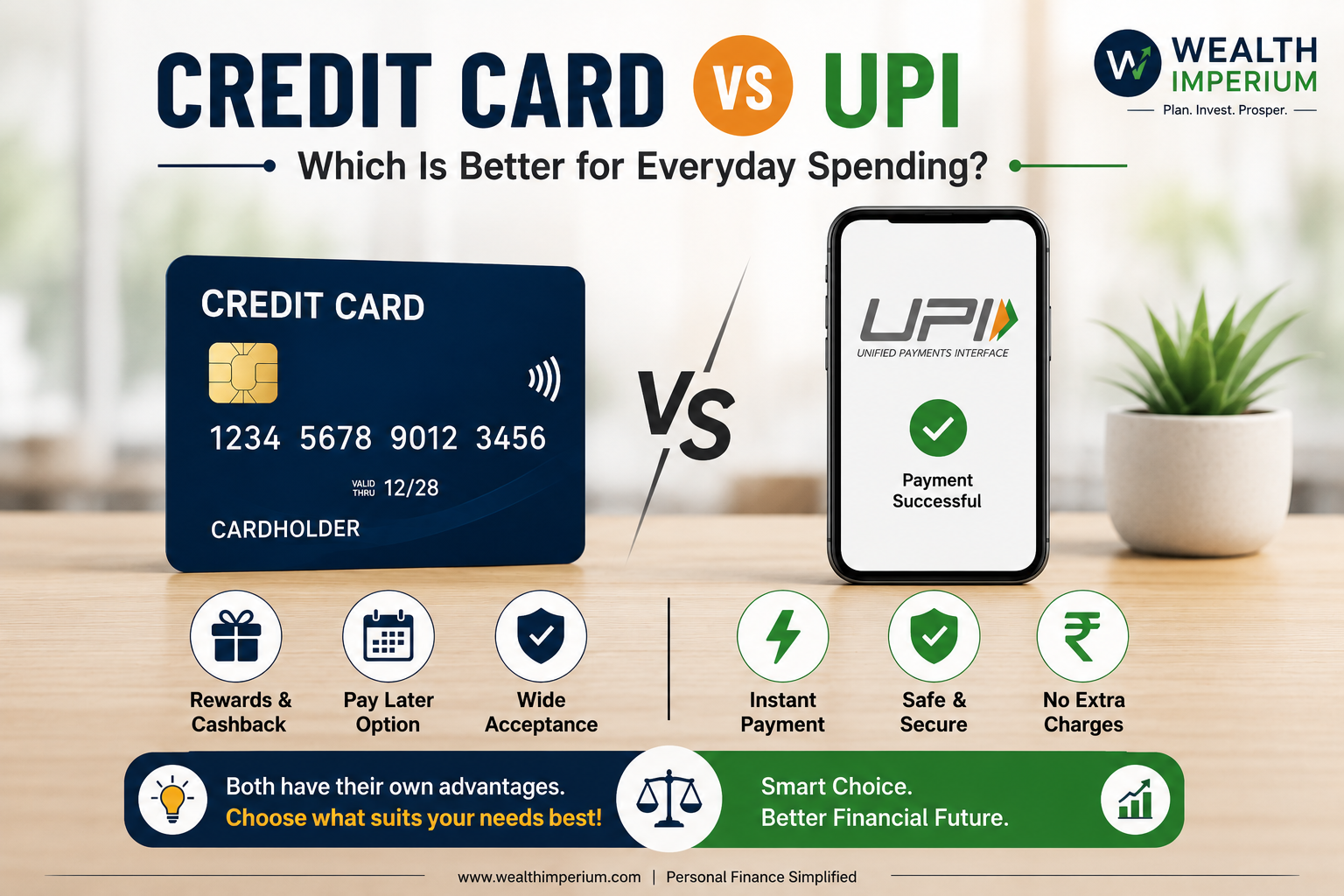
Credit Card vs UPI: Quick Answer
Here is the simple answer.
UPI may be better for you if:
- You want to spend money from your bank account.
- You make many small payments.
- You want to keep spending simple.
- You do not want to borrow money.
- You are learning how to manage a budget.
A credit card may be better if:
- You have a regular income.
- You can pay your bill on time.
- You want cashback or reward points.
- You use card offers often.
- You can control your spending.
There is also another option.
Eligible RuPay credit cards can be linked to UPI for supported merchant payments. However, not every UPI payment can be made with a credit card. Some types of transactions are not allowed. Always check the current rules before using the feature.
What Is UPI?
UPI stands for Unified Payments Interface.
It lets you make digital payments through a bank account linked to a supported UPI app.
For example, imagine that you buy groceries for ₹500.
You scan the shop’s QR code. Then, you enter the amount. After that, you approve the payment.
The money is taken from your linked bank account.
That is one reason UPI is so popular.
You do not need to carry cash. You also do not need to enter your bank details for every payment.
UPI can be used for many common payments, such as:
- Groceries
- Food
- Bills
- Travel
- Shopping
- Local stores
- Online payments
UPI has also grown very fast in India. NPCI’s official data shows that UPI processed more than 23 billion transactions in May 2026. (NPCI)
That shows how common digital payments have become.
What Is a Credit Card?
A credit card works in a different way.
When you use a credit card, the card company pays the merchant on your behalf. You then repay the card company later.
Your card comes with a credit limit.
For example, your card may have a limit of ₹50,000.
That does not mean you should spend ₹50,000.
It only means that the card company has approved that much credit, subject to its terms.
At the end of your billing cycle, you receive a statement. It shows your purchases and the amount you need to pay.
If you pay according to the card’s terms, you can avoid certain interest charges. However, carrying unpaid balances can become costly.
That is why a credit card should never be treated as free money.
Credit Card vs UPI: Main Difference
The biggest difference is simple.
UPI usually uses your own money.
A credit card uses borrowed money.
Let’s take a simple example.
You have ₹10,000 in your bank account.
You pay ₹1,000 using UPI.
Your available bank balance becomes about ₹9,000, subject to any other transactions.
Now imagine that you pay ₹1,000 using a credit card.
The money may not leave your bank account right away. Instead, the amount becomes part of your credit-card balance.
You will need to pay it later.
This is why credit cards need more discipline.
Credit Card vs UPI Comparison
| Feature | UPI | Credit Card |
|---|---|---|
| Money source | Bank account | Credit limit |
| Payment time | Usually now | Paid later |
| Cashback | Offer based | Card based |
| Rewards | May be available | Common on many cards |
| Interest risk | No credit-card interest | Possible if balance is carried |
| Small payments | Very easy | Easy where accepted |
| Budget control | Simple to track | Needs more discipline |
| Credit facility | No | Yes |
| Best for | Daily payments | Rewards and planned spending |
The exact fees, rewards, limits, and terms depend on your bank, card, app, and transaction.
Is UPI Better for Daily Spending?
For many people, yes.
UPI is simple. You pay directly from your linked bank account.
That can make it easier to understand how much money you have left.
Suppose you have a monthly budget of ₹20,000 for regular expenses.
You can use UPI for groceries, food, travel, and other daily needs.
As you spend, your bank balance changes.
This can help you stay aware of your spending.
However, UPI has one problem.
It is very easy to spend money.
A ₹100 purchase may not seem important.
Then you make another ₹200 payment.
Later, you order food for ₹400.
Small payments can add up.
Therefore, UPI is not a replacement for a budget.
You still need to track your spending.
Is a Credit Card Better for Daily Spending?
A credit card can be useful for daily spending if you use it carefully.
Many cards offer benefits such as:
- Cashback
- Reward points
- Shopping offers
- Dining offers
- Travel rewards
- Fuel benefits
- Special discounts
These benefits can be useful when they match your normal spending.
For example, if you already spend ₹5,000 a month on groceries and your card gives a useful reward on that category, the card may provide extra value.
However, there is a catch.
Do not spend more just to earn rewards.
If you spend ₹2,000 extra to get ₹100 cashback, you have not saved money.
You have spent more money.
That is why rewards should be a bonus.
They should not control your spending.
Credit Card vs UPI for Small Payments
UPI is very useful for small payments.
You may use it for:
- Tea
- Snacks
- Groceries
- Local transport
- Parking
- Food
- Small shopping
You can make these payments in seconds.
An eligible RuPay credit card can also be linked to UPI for supported merchant payments.
However, there are rules and limits.
NPCI says eligible RuPay credit cards can be linked to UPI for merchant payments. Some payment types are not allowed, including certain person-to-person transactions. (NPCI RuPay)
So, do not assume that every UPI payment can be made using your credit card.
Credit Card vs UPI for Online Shopping
Online shopping is one area where credit cards can be useful.
Some cards provide special discounts on selected websites.
Others offer cashback or reward points.
Before choosing your payment method, compare the final cost.
Ask yourself:
- Is there a credit-card discount?
- Is there a UPI offer?
- Will I receive cashback?
- Are there any fees?
- Do I need to spend more to get the reward?
- Can I pay the credit-card bill on time?
The best payment method is the one that gives you real value.
Do not choose a payment method only because an offer looks attractive.
Credit Card vs UPI: Which Gives Better Rewards?
Credit cards usually have more structured reward programmes.
Depending on the card, you may earn:
- Cashback
- Reward points
- Travel points
- Discounts
- Other card benefits
UPI apps may also provide cashback or other offers.
However, UPI offers can depend on the app, bank, merchant, or campaign.
So, there is no universal winner.
If you want rewards, look at your normal spending.
For example, a card may be great for online shopping but poor for groceries.
Another card may be better for travel.
The best card is not always the one with the highest advertised reward.
It is the one that fits your spending.
Can You Use a Credit Card With UPI?
Yes, but only in supported cases.
Eligible RuPay credit cards can be linked to UPI and used for supported merchant payments.
This means you may be able to scan a UPI QR code and pay with your linked RuPay credit card.
However, the feature has restrictions.
For example, NPCI says RuPay credit-card-on-UPI does not support certain person-to-person payments and some other transaction categories. (NPCI RuPay)
Also, your card issuer or UPI app may have its own conditions.
So, always check the current terms.
Credit Card vs UPI: Which Is Safer?
Both payment methods have security features.
Still, your own actions matter a lot.
UPI uses authentication before a payment is completed. NPCI also provides a complaint process for UPI transactions. (NPCI UPI)
You should follow a few basic rules.
Never share your UPI PIN
Your PIN is private.
No genuine person should need it from you.
Never share an OTP
Do not give an OTP to someone who calls you.
Check the name before paying
Before you approve a payment, check the receiver.
Check the amount
Make sure the amount is correct.
Avoid unknown links
Do not enter banking information on random websites.
These simple habits can reduce the risk of fraud.
Does UPI Build Your Credit Score?
This is where many people get confused.
A normal UPI payment from your bank account is not the same as borrowing through a credit card.
Therefore, you should not think of UPI as a credit-building tool.
A credit card is a credit product.
Responsible use and timely payments can help build a positive credit history.
However, you should not get a credit card only to build a credit score.
You also need to understand how credit works.
The most important habit is simple:
Never borrow more than you can repay.
The Biggest Credit Card Mistake
The biggest credit-card mistake is not choosing the wrong reward card.
It is spending more than you can repay.
Imagine you earn ₹500 in cashback.
That sounds good.
But if you carry an unpaid balance and pay much more in interest and charges, the cashback does not help much.
You may actually lose money.
So, don’t use a credit card to maintain a lifestyle you cannot afford.
Your credit limit is not your income.
It is also not your monthly budget.
The Biggest UPI Mistake
The biggest UPI problem is different.
It can make small spending feel harmless.
You pay ₹80.
Then ₹120.
Then ₹250.
None of these amounts looks huge.
But after a month, they can become a large expense.
A good habit is to check your UPI transactions once a week.
Look for:
- Unnecessary food orders
- Impulse shopping
- Unused subscriptions
- Repeated small purchases
- Expenses you could have avoided
This simple review can help you find where your money is going.
When Should You Use UPI?
UPI may be a good choice when:
- You want to pay directly from your bank account.
- You make small daily payments.
- You want simple money management.
- You want to avoid credit-card debt.
- You are trying to control your spending.
- You do not want another bill to manage.
For many beginners, UPI is easy to understand.
You spend the money that is already available in your account.
When Should You Use a Credit Card?
A credit card may make sense when:
- You have a regular income.
- You can pay your bill on time.
- You understand the card’s fees.
- You want cashback or rewards.
- You often use card discounts.
- You can control your spending.
A credit card can be useful.
However, it should not become a reason to spend more.
If you cannot repay the bill comfortably, UPI may be the better choice for that purchase.
Should You Use Both?
You don’t have to choose only one.
For many people, using both can work well.
You can use UPI for simple daily spending.
You can use a credit card for planned purchases or useful rewards.
For example:
UPI: groceries, local shops, small payments
Credit card: selected online purchases, travel bookings, eligible reward categories
This approach gives you more choice.
However, it only works when you keep your budget under control.
A Simple Payment Strategy for Beginners
Not sure where to start?
Try this system.
Step 1: Make a monthly budget
First, decide how much you can afford to spend.
Do not start with your credit limit.
Start with your income.
Step 2: Use UPI for normal expenses
Use UPI when direct payment from your bank account helps you stay within your budget.
Step 3: Use your credit card with a purpose
Use the card when it gives you a real benefit.
Do not use it just because you have available credit.
Step 4: Track your credit-card balance
Check your balance during the month.
Don’t wait for the statement.
Step 5: Pay your bill on time
Follow your card’s payment terms.
Avoid unnecessary interest and late charges.
Step 6: Review your spending
At the end of the month, check where your money went.
Then adjust your budget if needed.
Credit Card vs UPI for Students
Students often have limited income or a fixed monthly allowance.
For this reason, UPI can be easier to manage.
Suppose you have ₹5,000 for personal expenses.
If you use UPI, you can see your available bank balance reduce as you spend.
That can make budgeting easier.
A credit card may offer rewards. However, it also creates a future bill.
Therefore, students should focus on learning good money habits first.
Once they have regular income and understand credit, they can decide if a credit card is useful.
Credit Card vs UPI for Salaried People
For salaried people, both options can be useful.
You may use UPI for daily purchases.
Then, you may use your credit card for selected expenses where the rewards are worth it.
However, don’t let your credit limit increase your lifestyle.
Suppose your monthly income is ₹50,000.
A ₹1,00,000 credit limit does not mean you can spend ₹1,00,000 every month.
The money still has to be repaid.
A good rule is:
Budget first. Credit second.
How to Choose Between Credit Card and UPI
Before paying, ask yourself five questions.
1. Do I already have the money?
If yes, UPI may be simple.
2. Can I pay my credit-card bill?
If not, don’t use credit.
3. Is there a real reward?
Check the actual value.
4. Are there fees or conditions?
Read the current card terms.
5. Will this make me spend more?
If yes, stop and rethink the purchase.
These questions can help you make better decisions.
Credit Card vs UPI: Pros and Cons
UPI Pros
- Fast
- Easy
- Great for daily payments
- Direct bank-account payment
- Easy to use at many merchants
- No credit-card interest
UPI Cons
- Small payments can add up
- Offers can change
- Easy to make impulse purchases
- Requires your phone and payment setup
Credit Card Pros
- Cashback
- Reward points
- Discounts
- Payment flexibility
- Card-specific benefits
- Can support credit history when used responsibly
Credit Card Cons
- Interest can be costly
- Fees may apply
- Easy to overspend
- Rewards can encourage extra spending
- Requires bill management
Frequently Asked Questions
Is UPI better than a credit card?
UPI can be better for simple daily payments. A credit card can be better when you want rewards and can pay the bill on time.
Which is better for daily expenses?
It depends on your spending habits. UPI is useful for direct bank-account payments. A credit card can be useful when it gives you real rewards or discounts.
Can I use a RuPay credit card with UPI?
Yes. Eligible RuPay credit cards can be linked to UPI for supported merchant payments. Some transaction types are restricted. (NPCI RuPay)
Can I send money to a friend using a credit card on UPI?
The RuPay credit-card-on-UPI service does not support normal person-to-person payments. It is mainly intended for supported merchant payments. (NPCI RuPay)
Does UPI give cashback?
Some apps, banks, and merchants may offer cashback or other rewards. Offers can change, so check the current terms.
Does UPI increase your credit score?
Normal UPI payments from your bank account are not the same as using credit. UPI should not be treated as a credit-building tool.
Can every credit card be used on UPI?
No. Support depends on the card network, issuer, and UPI app. Eligible RuPay credit cards can be linked for supported merchant payments.
Which is safer, UPI or credit card?
Both have security features. Your own actions are also important. Protect your PIN, OTP, phone, and account information.
Should beginners get a credit card for cashback?
Only if they can manage the card and pay the bill on time. Cashback should never be a reason to spend beyond your budget.
Which is better for students?
UPI may be easier for students who want to control spending. A credit card can be considered later when they have stable income and understand credit.
Final Verdict: Credit Card or UPI?
So, which one should you choose?
There is no single answer.
UPI is excellent for simple daily payments.
It lets you pay directly from your bank account. It is quick and easy.
Credit cards are useful for planned spending and rewards.
They can provide cashback, points, discounts, and other benefits.
However, those benefits only matter when you use the card responsibly.
For eligible users, RuPay credit cards can also work through UPI for supported merchant payments. Still, some transactions are restricted.
Therefore, you don’t have to think of this as a battle between two payment methods.
You can use both.
Use UPI when you want simple spending from your bank account.
Use a credit card when the benefits are useful and you can repay the bill.
Most importantly, keep your budget in control.
A payment method should make your money easier to manage.
It should not make you spend more.
The Bottom Line
UPI is about convenience.
Credit cards are about credit and benefits.
The better choice is the one that fits your income, spending habits, and financial goals.
Good money management is not about getting the most rewards.
It is about keeping more of your money and avoiding unnecessary debt.
Key Takeaways
- UPI is useful for everyday payments.
- UPI usually takes money from your linked bank account.
- A credit card gives you a credit limit.
- Credit cards can offer cashback and rewards.
- Rewards should never encourage extra spending.
- UPI can make small purchases easy, so tracking still matters.
- Eligible RuPay credit cards can be used with UPI for supported merchant payments.
- Some credit-card-on-UPI transactions are restricted.
- You can use both UPI and credit cards.
- Your budget should always come before your credit limit.
Disclaimer
This article is for general educational purposes only. It is not personal financial advice. Credit-card fees, interest rates, rewards, eligibility, UPI features, and transaction rules can change. Always check the latest terms from your bank, card issuer, NPCI, and other official sources before making financial decisions.